
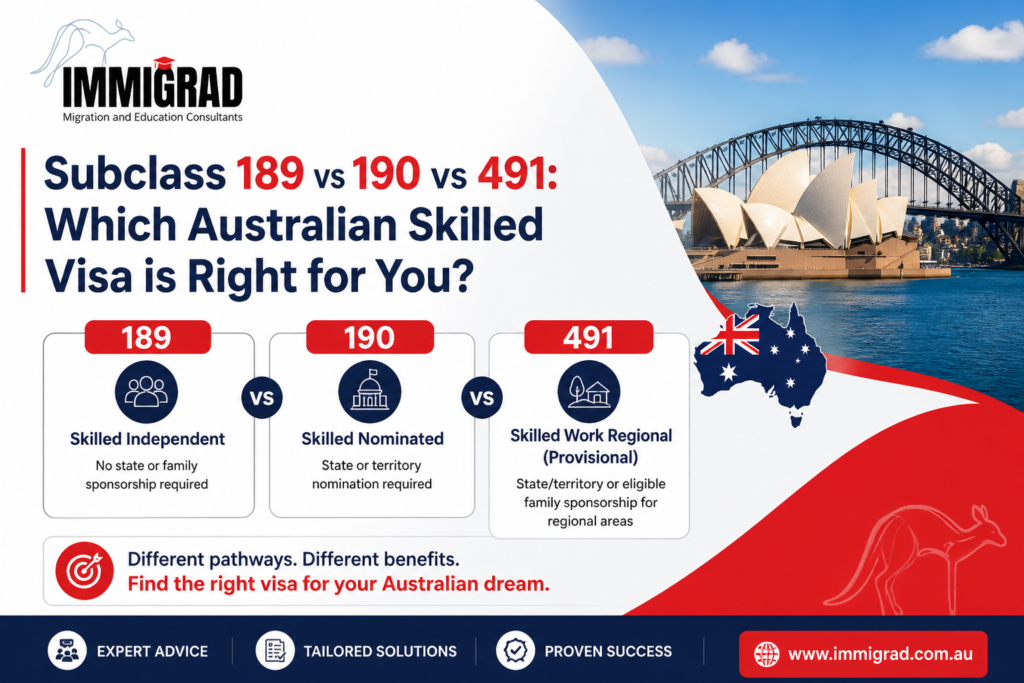
Choosing the right skilled visa is the most critical decision in your Australian migration journey. In 2026, the Department of Home Affairs has refined the migration program to be more targeted than ever, with a total ceiling of 185,000 places and a heavy emphasis on state-led and regional growth.
Whether you are an offshore applicant or currently in Australia on a temporary visa, the choice between Subclass 189, Subclass 190, and Subclass 491 will define your timeline, your flexibility, and your eventual path to citizenship.
1. Subclass 189: The Skilled Independent Visa
The “Gold Standard” of PR
The Subclass 189 remains the most prestigious visa because it offers total independence. You do not need a state to nominate you, and you do not need an employer to sponsor you. Once granted, you are a Permanent Resident with the freedom to live and work in any city or regional area in Australia.
Key 2026 Realities for Subclass 189:
- High Competition: With only 16,900 places allocated for the 2025–26 program, invitations are extremely selective.
- Occupation Specificity: Invitations are currently concentrated on “Critical Sectors”—specifically Healthcare, Teaching, and specialized Social Work.
- Points Floor: For non-healthcare roles, the “real” points requirement is often 95–100+.
Best for: Applicants in high-priority occupations with maximum points (Superior English, 8+ years experience, and aged 25–32).
2. Subclass 190: The Skilled Nominated Visa
State-Backed Permanent Residency
The Subclass 190 is also a permanent visa, but it comes with a “moral and residency obligation” to the state that nominates you. In exchange for 5 additional points on your test, you agree to live and work in the nominating state (like NSW or Victoria) for your first two years.
Key 2026 Realities for Subclass 190:
- State-Specific Lists: Each state (NSW, VIC, QLD, WA, etc.) has its own “Priority Occupation List.” You must match the specific needs of the state, not just the national list.
- Income & ROI: States like Victoria now use a Registration of Interest (ROI) system where they prioritize applicants with higher annual earnings or those working in “Future Industries” like Advanced Manufacturing or Renewable Energy.
- Points Floor: Generally requires 85–95 points (including the 5-point state bonus).
Best for: Skilled professionals who want PR immediately and are happy to commit to a specific state’s economy.
Confused between Subclass 189, 190, and 491 visas? 🤔
We’ve broken it down in a simple, easy-to-understand guide to help you choose the right pathway for Australia PR 🇦🇺
👉 Read now: Facebook
3. Subclass 491: Skilled Work Regional (Provisional)
The Strategic Regional Gateway
The Subclass 491 is a 5-year provisional visa. It is not PR on day one, but it provides a clear, guaranteed pathway to the Subclass 191 (Permanent Residence) after living and working in a regional area for 3 years.
Key 2026 Realities for Subclass 491:
- The 15-Point Boost: This is the visa’s greatest strength. It adds 15 points to your score, often making an invitation possible for those with a base score as low as 65.
- “Regional” is Bigger than You Think: In 2026, “Regional Australia” includes thriving cities like Perth, Adelaide, the Gold Coast, and Canberra. Only Sydney, Melbourne, and Brisbane are excluded.
- Work Flexibility: You can work in any occupation once you arrive in the regional area, provided you meet the residency and income requirements for the 191 PR transition later.
Best for: Applicants with lower point scores (65–75 base) or those whose occupations are only found on the “Regional Occupation List.”
4. Head-to-Head Comparison: 2026 Features
| Feature | Subclass 189 | Subclass 190 | Subclass 491 |
| Visa Status | Permanent | Permanent | Provisional (5 Years) |
| Points Bonus | 0 Points | +5 Points | +15 Points |
| Sponsorship | None Required | State/Territory | State OR Family |
| Where can you live? | Anywhere in Australia | Nominating State (2 yrs) | Regional Areas (3 yrs) |
| Occupation List | MLTSSL only | MLTSSL + STSOL | MLTSSL + STSOL + ROL |
| PR Pathway | Direct | Direct | Via Subclass 191 |
5. Which Visa Should You Choose?
Scenario A: The High-Scorer in Healthcare
If you are a Registered Nurse with 90 points, the Subclass 189 is your fastest route. You get total freedom and an invitation likely within weeks due to the high-priority status of your role.
Scenario B: The IT Professional in Sydney/Melbourne
If you have 80 points and work in Cybersecurity, the Subclass 190 in NSW or Victoria is your best bet. You gain the 5 points to reach 85, and your “onshore” status makes you highly attractive to state nominators.
Scenario C: The Offshore Applicant with 65–70 Points
The Subclass 491 is often the only viable path for offshore applicants in competitive fields like Marketing or HR. The 15-point boost takes you to 80–85 points, making you competitive for regional nomination in states like South Australia or Western Australia.
6. Expert SEO Advice for Your 2026 Application
- Don’t rely on 65 points: While it is the “legal” minimum, the “competitive” minimum for 189/190 is significantly higher.
- Max out your English: In 2026, a PTE score of 79+ (Superior English) is the single most important 20-point boost you can get.
- Check State “Openings”: State quotas in 2026 are being managed dynamically. A state might be “Open” in July and “Full” by October.
- The “Regional Advantage”: Moving to a Category 3 regional city (like Perth or Adelaide) is no longer a “sacrifice.” These cities have booming job markets and offer the most stable path to PR.
Final Verdict
- Choose 189 for Freedom.
- Choose 190 for Certainty.
- Choose 491 for Opportunity.
At Immigrad, we help you map out which of these three paths fits your career and family goals. The 2026 migration year is moving fast—ensure your EOI is optimized before the next invitation round.
Disclaimer: This information is current as of April 2026. Migration regulations change frequently; consult a MARA-registered agent at Immigrad for a formal assessment.
Subclass 189, 190 and 491: frequently asked questions
What is the difference between the subclass 189, 190 and 491 visas?
The subclass 189 is permanent and needs no sponsor or nominator. The subclass 190 is permanent and requires nomination by a state or territory government. The subclass 491 is provisional for 5 years and requires either state or territory nomination or sponsorship by an eligible relative, with residence in a designated regional area. All three are points tested and invitation only.
Which of the three is easiest to get?
There is no single easiest option, and the answer changes with occupation, points score and state programme. The 491 carries extra points and a smaller applicant pool, but it commits you to regional Australia for years. The 189 needs no nomination but invited scores are typically the most competitive. The right choice depends on your occupation and circumstances.
Do I need 65 points for all three visas?
Yes. The Department sets the points threshold at 65 for the subclass 189, 190 and 491. That is the minimum to be eligible for an invitation, not a score that secures one. Meeting the threshold does not guarantee an invitation, and state nomination programmes commonly apply their own higher expectations on top.
When can a 491 holder apply for permanent residence?
The Department states that a subclass 491 holder can apply for permanent residence 3 years from the time the visa is granted. Income and residence requirements apply for that permanent stage, and time spent outside a designated regional area does not help you meet them. The 491 itself is granted for 5 years.
Can I hold a 190 and live anywhere in Australia?
The subclass 190 is a permanent visa that lets you work and study anywhere in Australia. However, state and territory nomination is given on the basis of the commitment you make in your nomination application, and nominating bodies take that commitment seriously. Read your nominating state’s conditions before you apply.
How are these applications prioritised for processing?
The Department processes subclass 189, 190 and 491 applications under Ministerial Direction No. 119, which gives priority to Australian law enforcement and defence interests, then to construction, healthcare and teaching occupations from applicants who were in Australia when they applied. Current lodgement months being processed are published on each visa’s page and move over time.
This FAQ is general information only, current at 21 September 2026, and is not personal migration advice. State and territory nomination criteria change frequently and are set by each nominating body, not the Department. For advice on your circumstances, speak with a registered migration agent.