
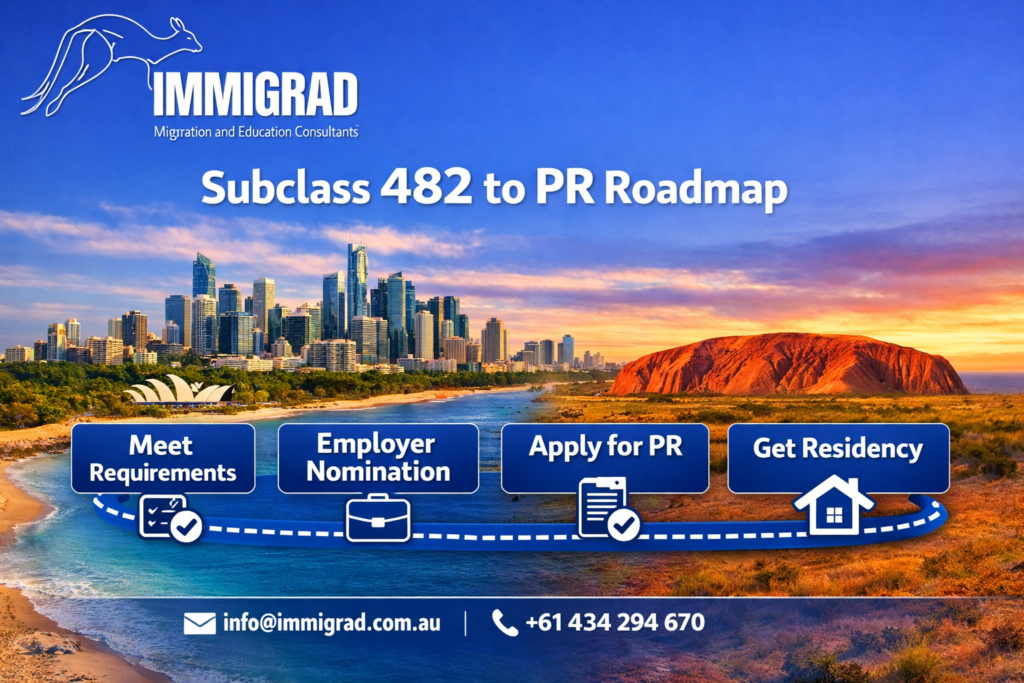
The dream of Australian Permanent Residency (PR) is more attainable than ever in 2026, thanks to a historic shift in the employer-sponsored migration framework. The Department of Home Affairs has effectively streamlined the transition from temporary work visas—including the legacy Subclass 482 (TSS) and the new Skills in Demand (SID) visa—to the Subclass 186 (Employer Nomination Scheme).
As of early 2026, the pathway has been shortened from three years to just two years. However, this faster route comes with stricter salary thresholds and a new “worker mobility” framework that you must navigate correctly to avoid resetting your PR clock.
This 2500+ word roadmap provides a definitive step-by-step guide on how to leverage your employer sponsorship into a permanent Australian life.
1. The 2026 Context: Why the Roadmap Has Changed
In 2025 and 2026, Australia overhauled its migration system to move away from “permanent temporariness.” The key legislative change was the universal expansion of the Temporary Residence Transition (TRT) stream.
The “Two-Year” Rule
Under previous laws, 482 visa holders (particularly in the Short-Term stream) were often blocked from PR. In 2026, all 482 and SID visa holders are eligible for PR through the 186 TRT stream, provided they have worked for their sponsoring employer for two out of the last three years.
The Core Skills Income Threshold (CSIT)
Salary is now the primary filter for PR.
- Current Threshold (April 2026): $76,515
- Upcoming Threshold (1 July 2026): $79,499
Critical Note: To secure PR, your nominated salary must not only meet these thresholds but also the Annual Market Salary Rate (AMSR)—ensuring you are paid the same as an Australian in an identical role.
2. Step 1: Evaluating Your Current Visa & Occupation
Before starting the roadmap, you must ensure your foundation is solid.
Occupations & Lists
While the 482 visa was tied to Short-Term and Medium-Term lists, the 2026 Core Skills Occupation List (CSOL) is more dynamic.
- If your occupation is on the CSOL, you are eligible for the 186 TRT stream.
- If you are in a high-salary bracket ($141,210+), you may qualify for the Specialist Skills Pathway, which offers even faster priority processing (median 7 days).
The 1-Year Experience Entry
In 2026, you can enter the 482/SID system with just one year of relevant work experience. This is a major win for onshore graduates who can now start their PR “two-year clock” much earlier than in previous years.
3. Step 2: The Two-Year Residency & Employment Phase
This is the most critical phase of the roadmap. To qualify for the 186 TRT stream, you must satisfy the “2-in-3” requirement.
The “Exact Employer” Constraint
As of late 2025, the work experience for the TRT stream must be with the exact same employer who is nominating you for PR.
- The Risk: If you change employers after 1.5 years, your clock resets to zero for the 186 TRT pathway.
- The Exception: If you change employers under the new 2026 mobility rules (which give you 180 days to find a new sponsor), you still hold a valid visa, but you must start a new two-year stint with the new sponsor before applying for PR.
Maintaining Compliance
Ensure your role remains “Skilled.” If your duties shift to a lower-level ANZSCO code, the Department may refuse your PR nomination on the grounds that the position is no longer genuine or at the required skill level.
4. Step 3: Employer Nomination (The Business Side)
The 186 visa is a two-part application: the Nomination (by the employer) and the Visa Application (by you).
Employer Requirements in 2026:
- Genuine Need: The business must prove they need a permanent employee in that specific role for at least the next two years.
- Training Requirement: Employers must show they are contributing to the Australian workforce (though the SAF Levy is generally applied at the temporary stage).
- Salary Audit: The employer must lodge evidence that the salary meets the indexed 2026 threshold ($76,515+ or the July update of $79,499).
Pro-Tip for SEO: If you are a business owner in the Kitchen Remodeling or Construction sectors in NSW, the 186 nomination is your best tool for retaining high-skilled site managers and project leads in the current labor shortage.
5. Step 4: The 186 Visa Application (The Personal Side)
Once the nomination is lodged (or concurrently), you submit your visa application.
“To share your opinions and questions, visit our Facebook page:”
Facebook
The Checklist for 2026:
- Age: You must generally be under 45 at the time of application.
- TRT Exemption: Some high-earners or those who worked through the COVID-19 period may still access exemptions.
- English Proficiency: You must demonstrate Competent English (IELTS 6.0 in each band or PTE 50 in each component).
- Skills Assessment: For the TRT stream, a formal skills assessment is not usually required if you have already held a 482/SID visa for two years. This is a massive advantage over the “Direct Entry” stream.
- Health & Character: Standard police clearances from every country you’ve lived in for 12+ months and a full Australian medical exam.
6. Step 5: Bridging to Approval
While your 186 is processing, you will likely be placed on a Bridging Visa A (BVA).
- Work Rights: You maintain full work rights.
- Travel: If you need to leave Australia during processing, you must apply for a Bridging Visa B (BVB) to ensure you can return.
Current Processing Times (April 2026):
- Healthcare & Teaching: 3–5 months.
- Core Skills (IT, Engineering): 10–14 months.
- Specialist Skills ($141k+): Under 1 month.
7. Common Pitfalls to Avoid in 2026
- Salary Slippage: If your salary is $77,000 in June 2026, you are safe. If your nomination is lodged in August 2026 and your salary hasn’t been increased to $79,499, it will be refused.
- The “Visa Hopping” Trap: New 2026 regulations prevent “visa hopping” to stay onshore indefinitely. Ensure your 482 to 186 transition is planned before your temporary visa expires.
- Inconsistent Duties: If your 186 nomination tasks differ significantly from your 482 visa tasks, the Department may question the “genuineness” of the role.
8. Conclusion: Your 2026 PR Strategy
The roadmap from 482 to PR is faster in 2026, but it requires more precise timing and salary management. By staying with a supportive sponsor for two years and ensuring your remuneration keeps pace with inflation-indexed thresholds, you can secure your future in Australia without the stress of the points-based system.
Action Plan:
- Year 1: Secure your 482/SID visa and confirm your salary meets the AMSR.
- Year 2: Document your work history and ensure your employer is ready to sponsor your nomination.
- Month 24: Lodge your 186 TRT application.
At Immigrad, we don’t just process visas; we manage the entire two-year journey. Whether you are an employee looking for a pathway or an employer looking to retain talent, we ensure every step of this roadmap is followed with precision.
Disclaimer: This information is accurate as of April 2026. Immigration policy is subject to change. Always consult with a MARA-registered migration agent at Immigrad for a formal assessment.
From 482 to permanent residency: questions
How do I move from a subclass 482 visa to permanent residency?
The usual route is the subclass 186 Employer Nomination Scheme, Temporary Residence Transition stream. You must generally have worked in eligible sponsored employment for at least two years full time while holding a subclass 457 or 482 visa, and hold an employer nomination that was approved in the six months before you apply. Meeting these criteria makes you eligible to apply.
How much does the subclass 186 visa cost?
The visa application charge for the Employer Nomination Scheme, subclass 186, starts at AUD 6,140 for the primary applicant, with further charges for accompanying family members. The employer separately pays a nomination charge of AUD 540, subject to stream and location, and the Skilling Australians Fund levy, which for the 186 is a one-off payment of AUD 3,000 or AUD 5,000 depending on business turnover.
Do the two years of sponsored employment have to be with the same employer?
The two years must be in eligible sponsored employment in the nominated occupation while holding a subclass 457 or 482 visa, and the nominating employer must be the employer nominating you for the 186. Periods with a previous sponsor are not automatically counted. If you have changed employers, have the history assessed before you rely on it.
What happens to my 482 visa while my 186 application is being processed?
Your existing visa continues until it expires or is otherwise ceased. If your subclass 482 visa expires while the permanent application is being processed, a bridging visa may apply, and its conditions may differ from your current ones. Check what conditions attach to any bridging visa before you change your work arrangements.
Can I apply for permanent residency if my occupation is no longer on the list?
It depends on the stream and the criteria in force when you apply. Occupation lists are amended from time to time and the requirements differ between the Temporary Residence Transition and Direct Entry streams. Where an occupation has moved or been removed, the position should be assessed against the current instruments before lodging.
This information is general in nature and current at September 2026. It does not take account of your circumstances. Fees, thresholds and requirements published by the Department of Home Affairs change; complex cases should be discussed with a registered migration agent.